
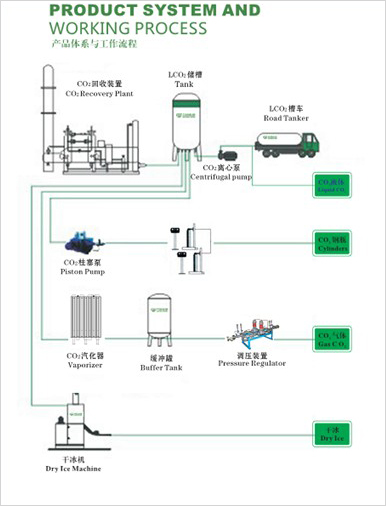
Flue gas generally refers to the high temperature and low carbon dioxide concentration tail gas released by coal, gas, oil or heating in power plants, boiler factories, lime kilns, cement plants, etc. Flue gas contains 8~35% CO2, this system uses MEA to absorb CO2 at room temperature, release CO2 at high temperature properties, use MEA solution to circulate and absorb CO2 in flue gas, and use flue gas heat to analyze to achieve the purpose of carbon dioxide concentration and recovery. After the concentration section, carbon dioxide is adsorbed, dried, cooled, heat exchanged, and enters the distillation column for rectification, removing impurities such as sulfur, nitrogen, oxygen, nitrogen, water vapor and storing it in a storage tank for user use. Fermentation gas generally refers to the high concentration of carbon dioxide exhaust gas released from fermentation systems such as alcohol plants, breweries, and sugar factories.
Fermentation gas generally contains 90~99% CO2, as well as alcohols, aldehydes, methane, hydrogen, nitrogen, water vapor and other impurities, and may contain a small amount of NO and oil. The system uses a combination of water washing, water separation and special adsorbents to remove alcohols, aldehydes, lipids, NO, etc., and uses drying, cooling, heat exchange and rectification column rectification to remove impurities such as water, methane, hydrogen, nitrogen, etc., and store them in a storage tank for user use. Petrochemical and chemical tail gas generally refers to the reaction from petrochemical plants, fertilizer plants, hydrogen plants and other chemical plants, and the high concentration of carbon dioxide tail gas released by the separation device. Petrochemical and chemical tail gas generally contains 80~99% CO2, as well as sulfur, carbon monoxide, hydrocarbons, hydrogen, nitrogen, oxygen, benzene, water vapor and other impurities. The system uses water washing, water separation and dust removal and cooling, special adsorbent adsorption desulfurization and dehydration, patented dehydrocarbon technology dehydrocarbonization, and combined with rectification column rectification to remove methane, hydrogen, nitrogen, carbon monoxide, oxygen and other impurities, stored in the storage tank for user use.






 客服1
客服1 客服2
客服2